Domenico Provenzani
(Palma di Montechiaro, 1736–1794)
His father Calogero, remembered as a skilled woodcarver and painter, gave him his first artistic training. Orphaned at an early age, he was supported by Prince Ferdinando Tomasi di Lampedusa, who encouraged his education.
Around 1750 Provenzani moved to Palermo, where he completed his artistic formation by working in the workshops of Gaspare Serenario and above all Vito D'Anna, one of the leading figures of eighteenth-century Sicilian painting. From these masters he absorbed the language of the Late Baroque and a taste for large, dynamic compositions.
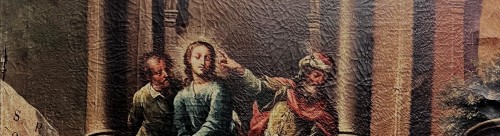
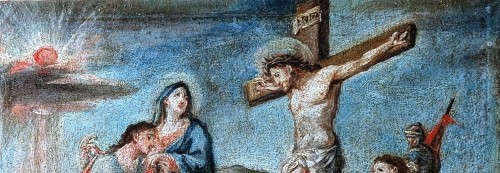
After returning to central-southern Sicily, he developed an intense artistic activity, working for churches and convents in many towns, including Agrigento, Licata, Naro, and Mussomeli. His production is almost entirely devoted to sacred painting: altarpieces, devotional canvases, and decorative cycles depicting episodes from the lives of Christ, the Virgin, and the saints.
His style is distinguished by lively colour, expressive figures, and a naturalistic sensitivity that brings religious scenes closer to the human experience of the faithful. Provenzani died on 29 January 1794 in his hometown of Palma di Montechiaro, leaving a substantial body of work that testifies to the spread of Late Baroque pictorial culture in eighteenth-century Sicily.
Padre Fedele da San Biagio
(San Biagio Platani, 1717 – Palermo, 1801)
Born Matteo Sebastiano Tirrito, he was a Capuchin friar, painter, preacher, and author of religious texts active during the eighteenth century.
After entering the Order of Friars Minor Capuchin, he combined religious life with intense artistic activity. Trained in Palermo, he further perfected his painting in Rome, where he came into contact with important masters of the time.
In 1744 he wrote Dialoghi sopra la pittura, a fundamental text of eighteenth-century art theory. His painting belongs to the artistic climate of the Sicilian Late Baroque and is characterized by a clear and devotional language, intended to accompany prayer and the religious instruction of the faithful.
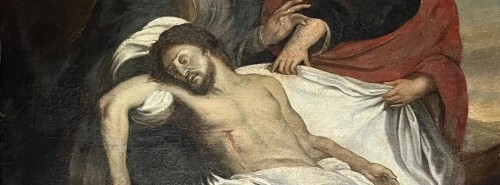
Numerous works are preserved in the Mother Church of Casteltermini, where he produced important canvases between the mid and late eighteenth century. Padre Fedele also played a significant role in the formation of other religious artists and in the dissemination of art within Capuchin convents. His activity demonstrates how convents in the eighteenth century functioned as centers of cultural and artistic production, where painting became a tool of evangelization and spiritual meditation.
Today he remains one of the most important Sicilian Capuchin painters of the eighteenth century.
Tommaso Rossi
(Rome, 1778 – Sciacca, 1862)
The son and pupil of Mariano Rossi (Sciacca, 1731 – Rome, 1807), one of the leading Italian painters of the second half of the eighteenth century, Tommaso spent his youth in Rome, where his father had lived for many years. He remained in the capital until the age of twenty-two, developing a visual culture shaped by the artistic environment and prestigious commissions surrounding his father.
Closely connected to the unmistakable artistic style of Mariano Rossi, Tommaso did not inherit his father’s extraordinary genius but belonged to the last generation of followers of the so-called “School of Sciacca,” together with painters such as Giuseppe Sabella and Giuseppe Cammarano.
Through his father he absorbed the atmosphere of grand Baroque decoration, assimilating its characteristics while gradually moving toward the stylistic principles of Neoclassicism, sometimes approaching the manner of artists such as Elia Interguglielmi.
Although he remained close to the chromatic palette and physiognomic types of his father, his work often shows greater rigidity and does not always achieve the same fluidity of brushwork or the dynamic classicizing spirit that characterized Mariano’s painting.
Among his most successful works are the frescoes on the vault of the Mother Church of Sciacca and the paintings in the Church of Purgatorio in the same town.
Federico Panepinto
(Santo Stefano Quisquina, 1809 – 1872)
After completing his studies at the Royal University of Palermo (the Accademia dell’Ignudo), he was awarded a gold medal as the best figure draftsman.
He attended the studio of Giuseppe Patanía, one of the leading artists of Sicilian Neoclassicism, and further specialized at the Royal Museum of Naples, a city he would visit again later in his career.
He served, at various times, as a teacher in the secondary school of his hometown. Family chronicles also record his revolutionary—or at least anti-Bourbon—sympathies. Despite this, he successfully balanced his civic convictions with the many commissions he received from ecclesiastical institutions and confraternities in towns such as Santo Stefano Quisquina, Bivona, Alessandria della Rocca, Casteltermini, Cammarata, Chiusa Sclafani, and Roccapalumba.
His most recognizable stylistic hallmark is a clearly Neoclassical approach. His work reveals a technically refined and somewhat solitary artistic research, aimed at renewing the artistic mentality of a conservative patronage still strongly attached to the fading Late Baroque tradition.
Panepinto’s Neoclassical experiments subtly reflect a modern vision connected with the emancipation from the ancien régime—a vision that in Sicily resonated with the anti-Bourbon statute of 1812, the abolition of feudal privileges, and the attempts to remove the Bourbons from the rule of the island.